Getting ready for the… IN BETWEEN… planting season

The fall garden is in, sprouting, and growing.  Whew, glad that’s done.  Of course that means that it is time to start planning for the SPRING garden!  I love that.  I love garden planning in general, I get really excited about it.  I could look through Baker Creek’s website for hours.

But here in AZ we have something… in between.  It’s not part of the of the fall garden, definitely not part of the summer garden… it’s more of an EARLY spring thing, or mid-winter thing (if we had a winter).  If you miss the fall planting, you still have a chance to do that.  In fact a lot of the things that you grow in the fall/winter here can also be planted in January to grow during the early spring.

A couple things, however need to be ready to be started in January.  Yup.  Kind of crazy huh?  They are both root crops.  The first one, that you need to preorder from someplace like here, is Jerusalem Artichokes or sun chokes.  I’ve never grown these before, but I am this year, or NEXT year… you know what I mean.  You have to preorder those NOW and they will ship them out mid-January… and that’s when you need to plant those little tubers.   Patience is key (from what I’ve read), since according to our planting calendar you won’t harvest these bad boys until late November or December.  Ouch.  Nothing like an 11 month growing season!  J

The second thing to be ready to get into the garden in January is potatoes, actually potato transplants.  So make sure that you start sprouting your little spuds in December, so that they are ready to go in the ground in MID-January.  If you don’t the tubers won’t have time to form before it gets too hot.   This is another crop I’ve never grown before, but I would LIKE to try this year.  Harvest is in May/June time frame, right about the same time your sweet potatoes are starting to take off.

Of course, it’s never too early to start thinking, planning, and dreaming about the spring garden!

As always, consult the growing calendar, here.  It has been very reliable for me over the last few years.

Posted in Arizona Garden, baker creek seeds, Jerusalem artichokes, potatoes | 4 Comments

Check, check, and… check

Buddy fence addition is complete.  It’s not pretty… but it’s complete.  The hens have been probing though.  I’m a bit nervous.  It’s like on Jurassic Park when the raptors are testing the electric fencing… something like that.

BIOCHAR! experiment is underway.

The main garden winter area is FINALLY planted.  Only a month and a half late 😦

I even went back and replanted some spots in the raised beds that hadn’t germinated.

So now I wait… and water… and… wait…

How if your fall garden going?

Posted in Arizona Garden, fall garden | 4 Comments

The chickens, the Buddy fence, and more planting

In order to keep my suburban, free ranging chickens in my yard I have clipped their wings.

It’s really not difficult.  My parents raised parrots for years and the concept is pretty easy.  When you look at a birds wings you will see two very distinct sets of feathers.  The long ones are the primaries and the shorter set are the secondaries.  Carefully, with a sharp pair of scissors, cut the primaries back to the secondaries.  Presto!  You’re done.

This does not mean, however, that you have eliminated their upward mobility.  Chickens have powerful legs!  Drumstick anyone?  Maybe a thigh?  So you understand what I am talking about.  Our Buddy fence (named after my son’s dog that destroyed my spring garden a couple years ago) is tall enough to keep Buddy out.  But not the chickens.  In one jump they manage to perch on the top of the fence, flapping their wings a couple of times to delude themselves into the idea that they can fly, but… it’s not really doing much at all.  It’s those drumsticks and thighs that get them up there.  So for a few weeks now they have been helping themselves to the garden.  The watermelon vines were their favorites but those are gone now.  I laid out a batch of compost on the area where I am fixing to plant and the last few days they have been in heaven scratching through that.

But it’s time to plant the main garden.  Well, technically it’s past time, but I’m finally getting around to it.

So the ladies got to go.

That’s right, I’m CUTTING YOU OFF, GIRLS!!! (insert maniacal laughter here)

Since I already have the Buddy fence I am just going to run some chicken wire next to it and zip tie it up.  It I need some extra rigidity I have a couple of long wooden stakes I can put up. It will be flimsy at the top which is good.  Birds don’t like to try and roost on things that are flimsy.  I’m hoping this does the trick.

Then I can plant!

Celery, cabbage (I need at least one good one, preferably two for St. Patty’s day corned beef and cabbage, although I would like some others for kraut), cauliflower (another first), and peas (I love peas, they rarely make it inside).

Free range chickens are great.  Free range chickens scratching to eat the seed you just planted, or the seedling that managed to survive the initial seed hunt, not so good.

Posted in Chickens | Tagged , | 6 Comments

Bed 2 Pictures

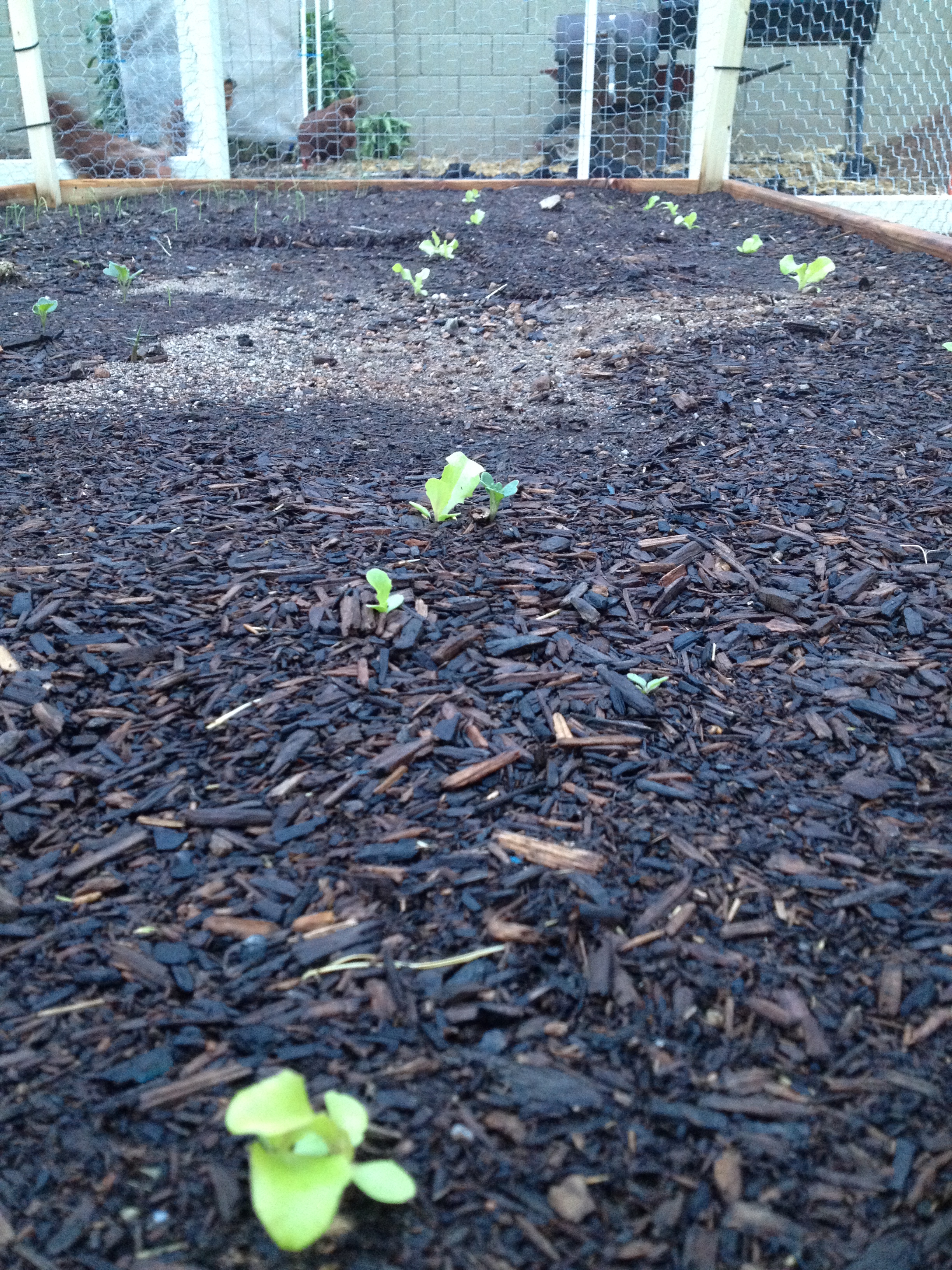
Bed 2 is coming along nicely, with a better germination rate, at this point, than any of the three other beds.  I think that has something to do with what was planted.  Romaine seems to be struggling.  I’m not sure if temperature has something to do with it or not, but we’ll see.

This is Dinosaur Kale coming along nicely.

IMG_1716[1]


The onions are awesome.

IMG_1720[1] IMG_1721[1]


The ice berg has had a great germination rate, especially considering it was planted by my six year old.

IMG_1719[1] Ice berg row

Grow little seedlings, grow!


Posted in dinosaur Kale, Ice Berg Lettuce, onions | 2 Comments

BIOCHAR!

I’m on a regular quest to improve my soil.  My latest inquiry has been into BIOCHAR!  I like to say it all dramatic like that because it’s a modern sounding name for something that has been around since… Adam.  But I have to admit that BIOCHAR! sounds a lot more intriguing than BURNT WOOD!

Just doesn’t have quite the same ‘ring’ does it.

Biochar is normally made by burning wood in a low oxygen environment.  This serves to produce a very fine and clean charred wood.  From what I’ve researched, this method for creating the biochar cleans up the pores in the wood by burning off excess debris and sap.  What is left over is black char that is very brittle.  In order to create this “low oxygen” environment you need a chamber that limits airflow.  There are numerous ways to create these chambers, but… yah, I’m not going to do that.  The main goal (from what I can tell) has less of an impact on the biochar than it does the environment.  The low oxygen environment creates a situation where more of the gases from the wood are consumed, giving off less pollutants.  At least that’s what it seems like; quite frankly I’ve found very few sites that clearly define WHY you want the low oxygen environment.

The whole idea for biochar actually comes from the rainforests where it was found that ancient indigenous people used burnt wood (however they produced it) to help their soil retain moisture and nutrients.  The soil in these areas receives so much rainfall that the nutrients tend to be short lived and pass right through to the ground water.  I’m not thinking that the ancient indigenous people created these fancy low oxygen kilns… although it is possible since a similar set up can be used for pottery…

But I’m getting off track.

I’m not building a special oven.

I’ve got excess, rotting wood, my waste company won’t collect it, it harbors bugs and makes a mess so I’ve got to get rid of it, so I’m burning it either way.  I might as well do some experimenting while I’m at it and not waste, what could possibly be, a valuable resource.

IMG_1708

Biochar acts like a sponge and holds moisture, something that is worth its weight in gold in AZ where the temps are not only high, but the humidity level frequently dips into the single digits.  It does other things too like creating an environment for different types of microbes and such, sequesters carbon out of the atmosphere for long periods of time, and holds nutrients.  But quite frankly I’m mainly interested in the moisture aspect.

As I was burning my first batch of wood I tried to keep an eye on the condition of the wood.  Normally during camping I just let the wood burn down to ash.  Ash is not what I’m going for here.  So as the wood was burning I pulled out the pieces that had turned to charcoal and hosed them down until they had stopped smoldering.

IMG_1712[1]

I broke up the pieces and put them in a bucket.  I’ll take my manual tamper and bust them up some more until they are small gravel sized pieces.

IMG_1713[1]

I plan on taking one bed of my main garden area and spreading at least a five gallon bucket of the BIOCHAR! over that area and mixing it into the compost that is already there.  I’ll plant what I had already planned in that area and observe the differences.

Sound good?

Posted in BIOCHAR | Tagged | 11 Comments